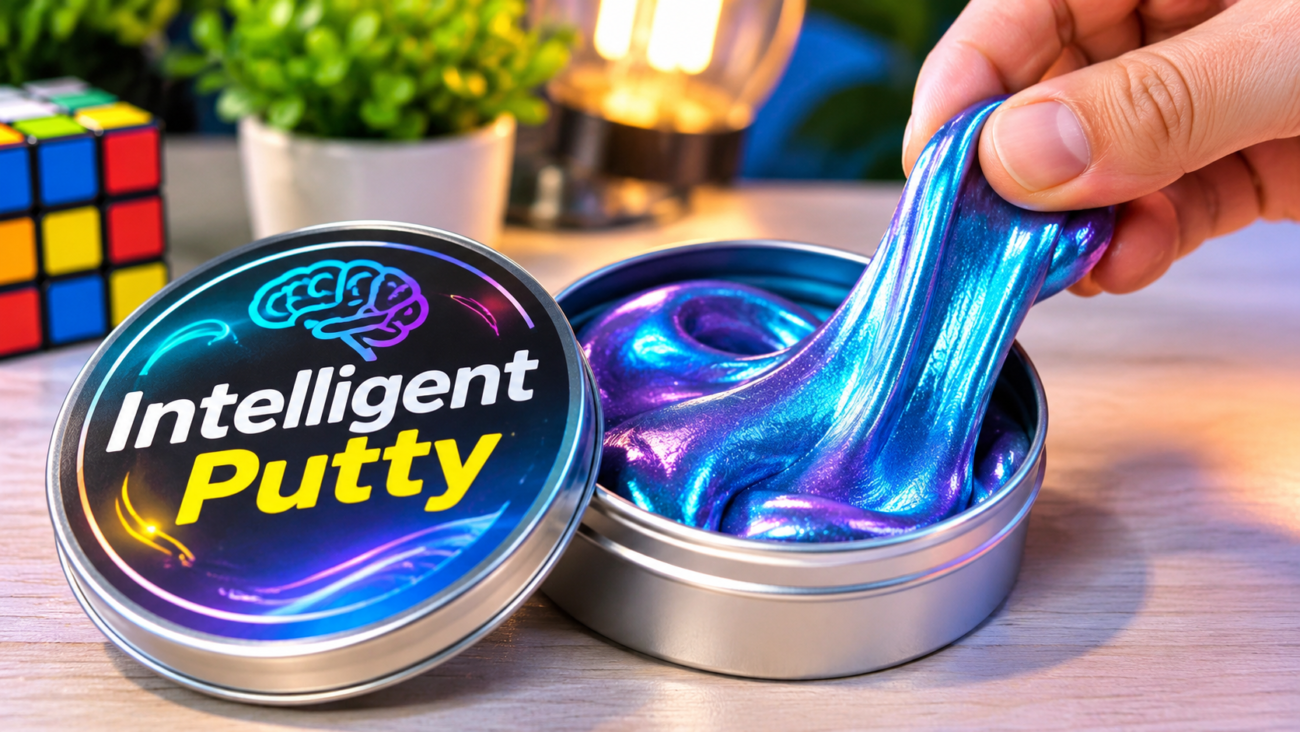
Intelligent putty is a unique, flexible material that offers much more than ordinary modeling clay. Known for its unusual physical properties, it can stretch like rubber, bounce like a ball, break when pulled quickly, and slowly change shape when left untouched. These characteristics make it an interesting material for children, adults, teachers, hobbyists, and anyone curious about science.
Unlike traditional clay, intelligent putty responds differently depending on how much force is applied and how quickly it is handled. This behavior makes it useful for sensory activities, creative play, educational demonstrations, and recreational purposes. Some varieties also offer additional features, including magnetic effects, glitter, color-changing properties, and different textures.
Despite the word “intelligent” in its name, the material contains no artificial intelligence or electronic technology. Its unusual behavior comes from its physical composition and material properties.
This article explains what intelligent putty is, how it works, its main features, practical benefits, everyday uses, applications, and important safety considerations.
What Is Intelligent Putty?
Intelligent putty is a soft, moldable substance designed to respond differently to different types of physical force. It is commonly sold as a sensory toy or specialty modeling material.
Its most interesting characteristic is that it can display properties associated with both solid and liquid materials. For example, when pulled slowly, it may stretch into a long, thin strand. When pulled suddenly, it can break apart. When shaped into a ball, certain varieties can bounce after being dropped onto a hard surface.
These behaviors make intelligent putty different from conventional modeling clay, which is generally designed to maintain its shape when molded.
The term intelligent putty is not a single standardized chemical formula. Different manufacturers produce different varieties, so the ingredients, texture, elasticity, color, and additional features can vary.
Some products are marketed as thinking putty, smart putty, or intelligent modeling clay. Although these names are sometimes used interchangeably, individual products may have different properties and intended uses.
How Does Intelligent Putty Work?
The science behind intelligent putty is closely related to a material property called viscoelasticity.
Viscoelastic materials display characteristics of both elastic solids and viscous liquids. Their response depends partly on how quickly force is applied and how long the force continues.
This explains why intelligent putty can behave differently during different activities.
Slow Stretching
When intelligent putty is pulled slowly, its internal material structure has more time to respond to the applied force. As a result, wide varieties can stretch into long strands without immediately breaking.
Sudden Pulling
When the material is pulled quickly, it may resist the sudden movement and break into separate pieces. This demonstrates how the speed of deformation can influence its physical response.
Bouncing
Some formulations can be shaped into small balls that bounce when dropped onto a hard surface. Their elastic response lets them return some of the energy they receive during impact.
Gradual Flowing
When left undisturbed, certain varieties slowly change shape under gravity. They may flatten or spread across a surface over time.
These properties make intelligent putty a useful way to demonstrate basic concepts in materials science and physics.
Main Features of Intelligent Putty
Intelligent putty combines several physical characteristics in one material. Although specific features depend on the manufacturer and formulation, the following are commonly associated with this product category.
1. Stretchable Texture
One of its most recognizable features is its stretchability. Users can pull, twist, roll, and reshape the material without necessarily breaking it.
This makes it suitable for hands-on activities and repeated manipulation.
2. Flexible and Moldable Structure
Intelligent putty can be shaped into different temporary forms. Users can create balls, ropes, patterns, and simple figures before reshaping the material.
Unlike many traditional clays, it is not primarily intended for producing permanent sculptures.
3. Bouncing Ability
Wide varieties can bounce when formed into a compact ball. This unusual characteristic makes the material interesting for simple experiments and recreational activities.
However, bouncing performance varies with formulation and environmental conditions.
4. Breaking Under Sudden Pressure
Intelligent putty can behave differently when force is applied rapidly. Instead of stretching, some formulations may snap or break apart.
This feature demonstrates the relationship between applied force and the rate of deformation.
5. Reusable Properties
Many commercial intelligent putties are designed for repeated use. They can generally be stretched, squeezed, folded, and reshaped several times.
Some silicone-based products are designed not to dry out under normal storage conditions. However, repeated exposure to dust, dirt, oils, and other contaminants can affect their condition.
6. Different Colors and Textures
Manufacturers offer different colors and visual effects. Depending on the product, these may include:
- Metallic finishes
- Glitter effects
- Transparent textures
- Color-changing properties
- Glow-in-the-dark effects
- Different levels of softness and firmness
Not every variety includes all these features.
7. Magnetic Variations
Some specialty putties are designed with magnetic properties. These products respond to an external magnet and can create interesting movement or shape changes.
Magnetic putty should not be confused with ordinary intelligent putty because its composition and safety requirements may differ.
Benefits of Intelligent Putty
Intelligent putty offers several practical and recreational benefits. Its value comes mainly from sensory interaction, creative activities, and opportunities to explore physical science.
1. Encourages Sensory Exploration
The material provides a distinctive tactile experience. Its soft, flexible, and sometimes elastic texture lets users explore different sensations by squeezing, stretching, rolling, and folding.
These activities can make sensory play more engaging, particularly for people who enjoy hands-on materials.
2. Supports Creative Thinking
Intelligent putty allows users to experiment with different shapes, textures, and movements. They can create temporary designs, test different techniques, and discover how the material responds to different actions.
This open-ended activity encourages curiosity and creative exploration.
3. Provides an Engaging Break
Some adults use intelligent putty as a desk toy or fidget object. Squeezing and reshaping it can provide an enjoyable activity during breaks from studying or working.
Individual experiences differ, however. It should not be considered a clinically proven treatment for anxiety, ADHD, or other medical conditions.
4. Introduces Basic Scientific Concepts
Intelligent putty offers an accessible way to explore scientific ideas.
Users can observe:
- Elasticity and deformation
- Viscous and elastic behavior
- The effects of applied force
- Gravity and gradual movement
- Material responses to different conditions
These observations can help make scientific discussions more practical and interesting.
5. Offers Repeated Play Opportunities
Wide varieties can be reused rather than discarded after one activity. As long as users maintain and store it according to the manufacturer’s instructions, they can repeatedly reshape and manipulate the material.
6. Suitable for Different Age Groups
Depending on the product’s safety instructions, intelligent putty can appeal to children, teenagers, and adults.
Children may enjoy its unusual movements, while adults may appreciate its tactile qualities and creative possibilities. Age recommendations should always be checked before purchasing.
Common Uses of Intelligent Putty
Intelligent putty can be used in several everyday situations. Its flexibility makes it suitable for activities that involve physical interaction, experimentation, and temporary modeling.
1. Sensory Play Activities
Sensory play is one of the most common uses of intelligent putty.
Children can explore its texture by:
- Squeezing it between their fingers
- Rolling it into different shapes
- Stretching it slowly
- Folding it repeatedly
- Creating small patterns
- Observing how it changes under pressure
These activities offer opportunities to explore touch, movement, and material behavior.
Adult supervision is important for younger children, especially if the product contains small accessories or has age restrictions.
2. Educational Science Experiments
Teachers and students can use intelligent putty to demonstrate basic material science concepts.
For example, students can compare what happens when the putty is stretched slowly and quickly. They can also investigate its bouncing behavior and observe how its shape changes over time.
Simple classroom experiments include:
Stretching experiment: Pull the material slowly and observe how far it stretches before breaking.
Bouncing experiment: Shape it into a ball and observe how it responds when dropped onto a suitable hard surface.
Gravity experiment: Place a small amount on a flat surface and observe whether its shape changes over time.
Temperature comparison: Compare samples at different temperatures, following the manufacturer’s guidance, and observe whether their flexibility changes.
These experiments encourage observation, comparison, and scientific questioning.
3. Creative Modeling
Intelligent putty can be used for temporary modeling and simple creative projects.
Users can make different shapes, patterns, and decorative designs. Some varieties also include glitter, metallic finishes, or color-changing effects that make creative activities more visually interesting.
However, traditional modeling clay may be a better choice for detailed sculptures or projects that need to retain their shape permanently.
4. Desk and Office Activities
Some people keep intelligent putty at their desks as a small recreational object.
During suitable breaks, they can stretch, squeeze, or reshape it while taking a break from computer work or reading.
It is particularly convenient because many products come in compact containers that are easy to store.
5. Hobby and Craft Projects
Certain specialty putties can also be useful for hobby-related activities. Their temporary, moldable structure lets users experiment with shapes and surface impressions.
However, ordinary sensory putty should not automatically be treated as a professional adhesive, sealant, repair compound, or industrial modeling material.
The intended purpose depends on the specific formulation.
Applications of Intelligent Putty in Different Fields
Although intelligent putty is primarily marketed as a recreational and sensory product, its physical properties create several opportunities for educational and creative applications.
Educational Applications
In schools and learning environments, intelligent putty can help demonstrate material behavior.
Teachers can use it to introduce concepts such as elasticity, viscosity, deformation, and the effects of force.
It can also support interactive learning activities where students make predictions, run simple experiments, and compare observations.
Recreational Applications
Intelligent putty is commonly used for entertainment and leisure.
Its unusual physical properties provide an alternative to conventional modeling clay and other small desk toys. Different textures and visual effects also give users more opportunities to experiment.
Sensory Activity Applications
The material can be incorporated into supervised sensory activities involving touch and movement.
For example, users can compare soft and firm varieties or explore how the same material feels when squeezed, stretched, and rolled.
These activities should be adapted to the individual’s age, preferences, and abilities.
Hobby and Creative Applications
Some varieties can be used for temporary shapes, surface impressions, and creative experiments.
Specialty formulations may offer additional properties that make them suitable for particular hobby activities. Product instructions should be checked before using putty on other materials or surfaces.
Intelligent Putty vs. Traditional Modeling Clay
Although both materials can be shaped by hand, intelligent putty and traditional modeling clay have different characteristics.
| Texture | Usually flexible and elastic | Often firmer |
| Stretching | Can stretch considerably | Usually less stretchable |
| Bouncing | Some varieties can bounce | Generally does not bounce |
| Sudden pulling | May break apart | Usually deforms or separates |
| Slow movement | Some varieties gradually flow | Usually maintains its shape better |
| Reusability | Many varieties are reusable | Depends on the clay |
| Main purpose | Sensory play and experimentation | Modeling and sculpting |
| Special effects | Available in selected varieties | Depends on the product |
Neither material is universally better. The right choice depends on the intended activity.
Intelligent putty is particularly interesting for sensory exploration and demonstrations of physical behavior. Traditional modeling clay is generally more practical for projects that require controlled shaping and stable forms.
Different Types of Intelligent Putty
Intelligent putty is available in different varieties. Understanding these options can help buyers select a product that matches their interests.
Standard Intelligent Putty
Standard versions offer the basic characteristics of moldable putty. You can squeeze, roll, stretch, and reshape them.
They are generally suitable for everyday recreational activities.
Magnetic Intelligent Putty
Magnetic versions respond to external magnets. Depending on their formulation, they may move or gradually change shape when a suitable magnet is brought nearby.
These products require additional care because magnetic components can create safety risks if swallowed.
Color-Changing Intelligent Putty
Some products change appearance in response to temperature changes or other manufacturer-designed effects.
These varieties add a visual element to ordinary putty activities.
Glitter and Metallic Putty
Glitter and metallic varieties have decorative appearances. They are particularly suitable for users who enjoy visually interesting sensory and creative materials.
Transparent Intelligent Putty
Transparent varieties offer a different appearance from traditional colored putty.
Their glass-like look can make them appealing for creative activities and visual experimentation.
How to Choose the Right Intelligent Putty
Choosing an appropriate product depends on its intended use, material properties, and safety information.
Consider the following factors before purchasing.
Check the Material and Product Description
Read the product description to understand what type of putty you are buying. Different products may have different ingredients, textures, and physical properties.
Do not assume that every product marketed as intelligent putty has identical characteristics.
Consider the Intended Age Group
Check the manufacturer’s recommended age range and warnings.
Some varieties may contain small components or magnetic elements that require additional precautions.
Choose the Desired Texture
Some users prefer soft, stretchy putty, while others prefer firmer materials.
If possible, review the manufacturer’s description to understand the expected consistency.
Look at Additional Features
Decide whether you want standard putty or a specialty version.
For example, magnetic, glitter, transparent, and color-changing varieties offer different experiences.
Check Storage Instructions
Choose a product with clear storage and maintenance instructions.
Wide varieties come in reusable containers that help protect the material from dust and other contaminants.
Safety and Care Tips for Intelligent Putty
Although many commercial products are designed for recreational use, intelligent putty should still be handled responsibly.
The following precautions can help maintain the material and reduce avoidable risks.
- Avoid swallowing: Intelligent putty is not food and should never be placed in the mouth.
- Follow age recommendations: Choose products according to the manufacturer’s age guidance.
- Supervise young children: Keep the material away from children who may put it in their mouths.
- Be careful with magnetic versions: Small or powerful magnets can cause serious internal injuries if swallowed. The U.S. Consumer Product Safety Commission highlights the dangers of magnet ingestion.
- Keep hands clean: Wash and dry your hands before handling the material.
- Avoid dirty surfaces: Dust, fibers, oils, and other contaminants can affect its texture.
- Store it properly: Return the putty to its original container when finished.
- Check the packaging: Follow any product-specific warnings and instructions.
The US Consumer Product Safety Commission also explains that small toy components can present choking hazards for children under three.
If a child swallows a magnet or you suspect magnet ingestion, seek immediate medical attention.
Does Intelligent Putty Dry Out?
This depends on its formulation.
Many silicone-based intelligent putties are designed to remain flexible without drying out like conventional water-based modeling materials.
However, that doesn’t mean every product lasts indefinitely. Exposure to dirt, fibers, oils, unsuitable storage conditions, and repeated handling can affect its quality.
Following the manufacturer’s care instructions is the best way to maintain its original properties.
Is Intelligent Putty Worth Using?
Intelligent putty can be a worthwhile choice for people who enjoy sensory activities, creative experiments, and unusual materials.
Its ability to stretch, bounce, break, and gradually change shape makes it more interactive than ordinary modeling clay.
For teachers, it offers a practical way to introduce basic scientific concepts. For children, it can provide an engaging material for supervised exploration. Adults may enjoy using it as a small recreational desk object.
However, choose the right variety and understand its limitations. Intelligent putty is not a replacement for professional therapy materials, industrial compounds, or permanent modeling products.
Frequently Asked Questions About Intelligent Putty
Is intelligent putty made with artificial intelligence?
No. Intelligent putty contains no artificial intelligence, sensors, or electronic components. Its name refers to its unusual physical behavior when different forces are applied.
What makes intelligent putty different from slime?
Intelligent putty generally has a firmer, more elastic consistency than many slime products. It may stretch slowly, bounce, or break under sudden force. Slime is usually softer and more fluid, although both categories include different formulations.
Can intelligent putty be reused?
Yes. Wide commercial varieties are designed for repeated use. Proper storage and clean handling help maintain their texture and flexibility.
Is intelligent putty suitable for children?
Some products are designed for children, but the recommended age depends on the formulation and product instructions. Always check the packaging and supervise younger children.
Can intelligent putty help with stress?
Some people enjoy squeezing and reshaping putty as a recreational fidget activity. They may find the repetitive movements relaxing, but there is insufficient evidence to consider ordinary intelligent putty a medical treatment for stress or anxiety.
What is magnetic intelligent putty?
Magnetic intelligent putty is a specialty variety that responds to an external magnet. Its movement and appearance can change when a magnet is placed nearby. Follow the manufacturer’s safety instructions when handling magnetic products.
Can intelligent putty be used for school experiments?
Yes. It can demonstrate physical concepts such as elasticity, deformation, gravity, and viscoelastic behavior. Simple stretching, bouncing, and slow-flowing experiments can make science lessons more interactive.
Conclusion
Intelligent putty is an interesting moldable material that combines sensory play, creative possibilities, and basic scientific exploration. Its ability to stretch, bounce, break under sudden force, and gradually change shape makes it different from conventional modeling clay.
It can be useful for educational demonstrations, recreational activities, temporary modeling, and supervised sensory exploration. Different varieties also provide additional features such as magnetic responses, glitter, transparent textures, and color-changing effects.
The most important consideration is choosing a product that matches the intended activity and following its safety and storage instructions. With proper handling, intelligent putty can offer an enjoyable, educational experience for a wide range of users.
