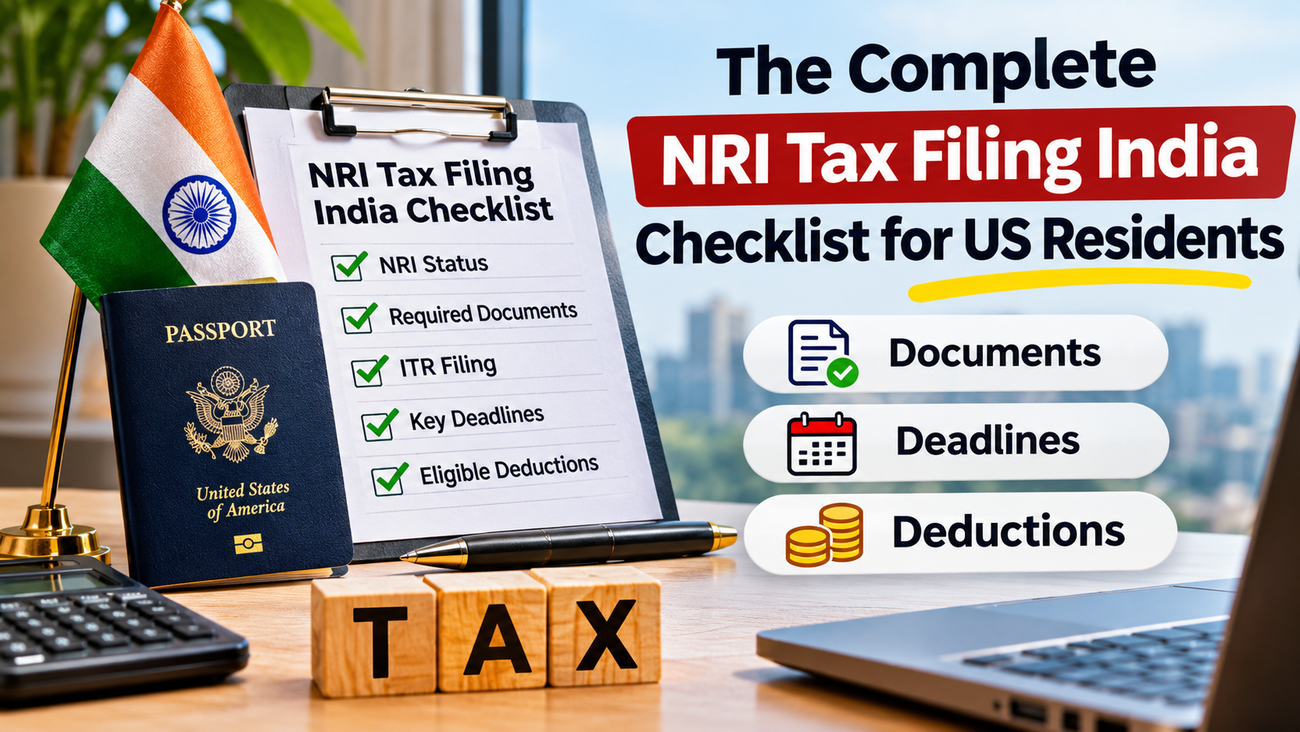
For Indian nationals living and working in the United States, tax obligations do not stop at the American border. India’s income tax framework applies to certain categories of income earned or received in India, regardless of where a person resides. This creates a parallel compliance requirement that many NRIs discover only after several years abroad — sometimes after penalties have already begun to accrue.
The challenge is not just filing a return. It is knowing whether you are required to file, what income falls within India’s tax jurisdiction, which documents you need to gather from both countries, and how to avoid being taxed twice on the same earnings. For US residents with Indian rental income, capital gains from property or mutual funds, interest from NRO accounts, or income from Indian business interests, the obligation is real and ongoing.
This checklist is structured to help NRIs in the US approach the Indian tax filing process with clarity — from residency determination through final submission.
Understanding Your Residential Status Before Filing Anything
India’s Income Tax Act defines tax liability based on residential status, not citizenship. The classification determines which income is taxable in India and which is not. Before gathering documents or calculating deductions, every NRI must correctly determine their status for each financial year.
The two primary categories relevant to NRIs are Non-Resident Indian (NRI) and Not Ordinarily Resident (NOR). An individual qualifies as a non-resident if they spend fewer than a specified number of days in India during the financial year. This threshold can shift depending on how long a person has been abroad and whether they have income from India above a basic threshold. The rules around this have been amended several times, and those with extended overseas stays should verify their status annually rather than assuming it remains unchanged.
When approaching nri tax filing india obligations, correctly identifying residential status is the foundational step — it determines the entire scope of what must be reported, what can be excluded, and which ITR form applies. A detailed breakdown of the residency rules under Indian law is available through nri tax filing india resources designed specifically for US residents navigating this dual-country compliance structure.
For NRIs, only income that originates from India is taxable in India. This includes rental income from Indian property, interest on NRO accounts, capital gains on Indian assets, dividends from Indian companies, and income from Indian business operations. Income earned exclusively in the US — salaries, US investments, US property — is outside India’s jurisdiction for a non-resident.
Why Residency Errors Create Downstream Problems
Filing under the wrong residential status creates compounding issues. If an NRI mistakenly files as a resident, their global income becomes taxable in India — including US salary, US interest, and US investments. This can lead to significant unexpected tax demands, plus the administrative burden of rectifying returns across multiple years.
Conversely, if someone who has returned to India and resumed residency continues to file as an NRI, they may underreport taxable income, triggering scrutiny and penalties. Residential status must be recalculated from scratch at the start of every financial year using actual days of presence in India.
The Document Checklist Every US-Based NRI Needs
Indian tax filings for NRIs require documentation from both countries. Many NRIs underestimate the cross-border nature of this document collection process and find themselves scrambling close to the deadline. Organizing these documents in advance significantly reduces errors and filing delays.
Indian Income and Account Documents
The core documents required from the Indian side of your financial life include the following:
• Form 26AS from the Income Tax portal, which shows all tax deducted at source (TDS) against your PAN for the financial year — this is the baseline reconciliation document
• Annual Information Statement (AIS) and Taxpayer Information Summary (TIS), introduced in recent years to capture a broader picture of financial transactions including interest, dividends, and securities transactions
• Bank statements from NRO accounts, which carry taxable interest subject to TDS deduction
• Bank statements from NRE accounts, which are exempt from Indian income tax on interest but should still be documented for consistency
• Rental income records including rent agreements, rent receipts, and municipal tax payment proofs if applicable
• Capital gains statements from mutual fund houses or brokers for any sale of Indian mutual funds, equities, or property during the financial year
• Property sale deed and purchase deed if real estate was transacted, along with cost of improvement records and stamp duty receipts
• Dividend income records from Indian companies or REITs
US-Side Documents for DTAA Claims and Foreign Tax Credits
India and the United States have a Double Taxation Avoidance Agreement (DTAA) in place. Under this agreement, NRIs may be able to claim credit for taxes paid in India against their US tax liability, or vice versa, depending on the nature of the income. To support these claims on either return, documentation from both countries is required.
• US federal tax return (Form 1040) for the relevant year, particularly if claiming foreign tax credit in the US for TDS paid in India
• IRS Form 1116 if claiming foreign tax credit on the US return
• FBAR filing records if Indian accounts exceed the reporting threshold, as this is a parallel US obligation that intersects with the Indian filing process
• W-2 or 1099 forms to confirm that US income is not being inadvertently included in Indian income declarations
Deadlines and Filing Timelines for NRIs in the US
India’s financial year runs from April 1 to March 31. The income tax return for a given financial year is filed in the following calendar year. For most individual taxpayers, including NRIs, the standard filing deadline falls in late July of the year following the financial year end.
NRIs whose accounts are subject to audit face a later deadline, typically in October. However, for most US-based NRIs with passive Indian income such as rent or interest, the standard deadline applies. Missing this deadline without filing a belated return before December 31 of the same calendar year results in penalties and loss of the ability to carry forward certain losses.
TDS Refunds and Why Timely Filing Matters
Many NRIs have tax deducted at source on NRO account interest or rental income at a flat rate that may be higher than their actual tax liability. The only mechanism to recover excess TDS is through filing a return and claiming a refund. This refund is not automatic — it requires a correctly filed return, accurate reconciliation with Form 26AS, and an active bank account linked to the PAN for direct credit.
Delays in filing translate directly to delays in receiving these refunds, which can represent meaningful sums for NRIs receiving regular Indian income over multiple years.
Deductions Available to NRIs Under Indian Tax Law
A common misconception is that NRIs have very limited access to deductions under Indian tax law. While it is true that some deductions available to resident Indians are not available to non-residents, there are still significant deductions that apply and should be claimed where eligible.
Under the old tax regime, NRIs may claim deductions for life insurance premiums paid on policies held in India, repayment of home loan principal on Indian property, interest on home loans under Section 24, and tuition fees paid for education in India. Contributions to certain pension schemes and equity-linked savings schemes may also qualify under specific conditions.
As part of the nri tax filing india process, understanding whether the old or new tax regime is more beneficial is a decision that depends heavily on the composition of Indian income. The new regime offers lower slab rates but eliminates most deductions. For NRIs with substantial home loan interest or significant life insurance premiums, the old regime may produce a lower effective tax liability even with higher slab rates.
Standard Deduction on Rental Income
Rental income from Indian property is not taxed on the gross amount received. Indian tax law permits a standard deduction of thirty percent of the net annual value of the property, which reduces the taxable rental income without requiring itemized documentation of maintenance or repair costs. Property taxes paid to local municipal authorities are additionally deductible from the gross rental value before the standard deduction is applied.
NRIs who own multiple properties in India should determine which properties are deemed let out and which are self-occupied, as the tax treatment differs significantly. Properties treated as self-occupied carry no income but do allow home loan interest deductions up to the applicable limit.
Common Compliance Gaps That Create Risk
Several patterns appear regularly among US-based NRIs who have been managing their Indian finances without formal guidance. These are not unusual oversights — they reflect how gradually the compliance burden grows as income sources accumulate over years abroad.
• Operating an NRO account with regular interest accruals without filing returns, assuming the TDS deducted represents full settlement of tax obligations
• Selling inherited Indian property and not filing for the year of sale, missing the requirement to report capital gains even when TDS was deducted by the buyer
• Holding Indian mutual fund investments without tracking redemptions, leading to unreported capital gains across multiple years
• Failing to link Aadhaar with PAN, which affects the ability to file returns and can render a PAN inoperative
• Not updating residential status with Indian banks, resulting in incorrect tax deduction rates applied to accounts
The Income Tax Department of India, as outlined on the official portal at incometax.gov.in, provides access to Form 26AS, AIS, and return filing facilities that NRIs can access with a valid PAN and registered email or mobile number. Keeping these credentials current is a basic operational requirement for staying compliant from abroad.
Conclusion: Treating Indian Tax Compliance as an Ongoing Process
For US-based NRIs, Indian tax compliance is not a one-time task. It is an annual obligation tied to the structure of financial interests maintained in India — property, bank accounts, investments, and business income. The complexity grows as those interests evolve, and the consequences of unaddressed gaps tend to accumulate quietly until they require significant effort to resolve.
Approaching nri tax filing india obligations with a structured annual process — confirming residential status, gathering documents from both countries, understanding applicable deductions, and filing within the deadline — creates a sustainable system rather than a recurring emergency. The goal is not perfection on the first attempt. It is building a reliable annual process that keeps obligations current, refunds flowing, and exposure to penalties minimal.
NRIs who have multiple years of unfiled returns or unreconciled TDS should address these through the available channels for updated returns and voluntary disclosure rather than allowing the gap to widen further. The Indian tax framework does provide structured pathways for correction, and acting on them proactively is almost always preferable to waiting for a notice to arrive.
